
You’ve done the hard work of setting up your blog. You’ve addressed major blog blunders, you’re publishing consistently, and traffic is up! Your hard work is finally paying off! Or is it?
Some time goes by, and your website is gaining traffic, but this traffic isn’t converting to anything meaningful for your business.
What’s going on?
This is a familiar pattern for many small B2B businesses. A blog launches with the right intentions: build awareness, attract visitors, and eventually bring in buyers. The awareness part usually works. What proves more challenging is translating that attention into action.
Most people will blame the content. And it isn’t necessarily a quality issue (although sometimes it can be). It’s that the entire approach wasn’t designed to convert, only to attract. Traffic is only useful when it attracts the right visitors and provides clear, intentional paths to becoming buyers.
Once you understand where the disconnect is happening, the path forward becomes much clearer. Small adjustments can dramatically improve how your content attracts, engages, and moves the right readers closer to becoming customers.

Struggling With Your B2B Content Strategy?
I help small B2B teams turn content into a focused, strategic asset.
Too Much TOFU Content
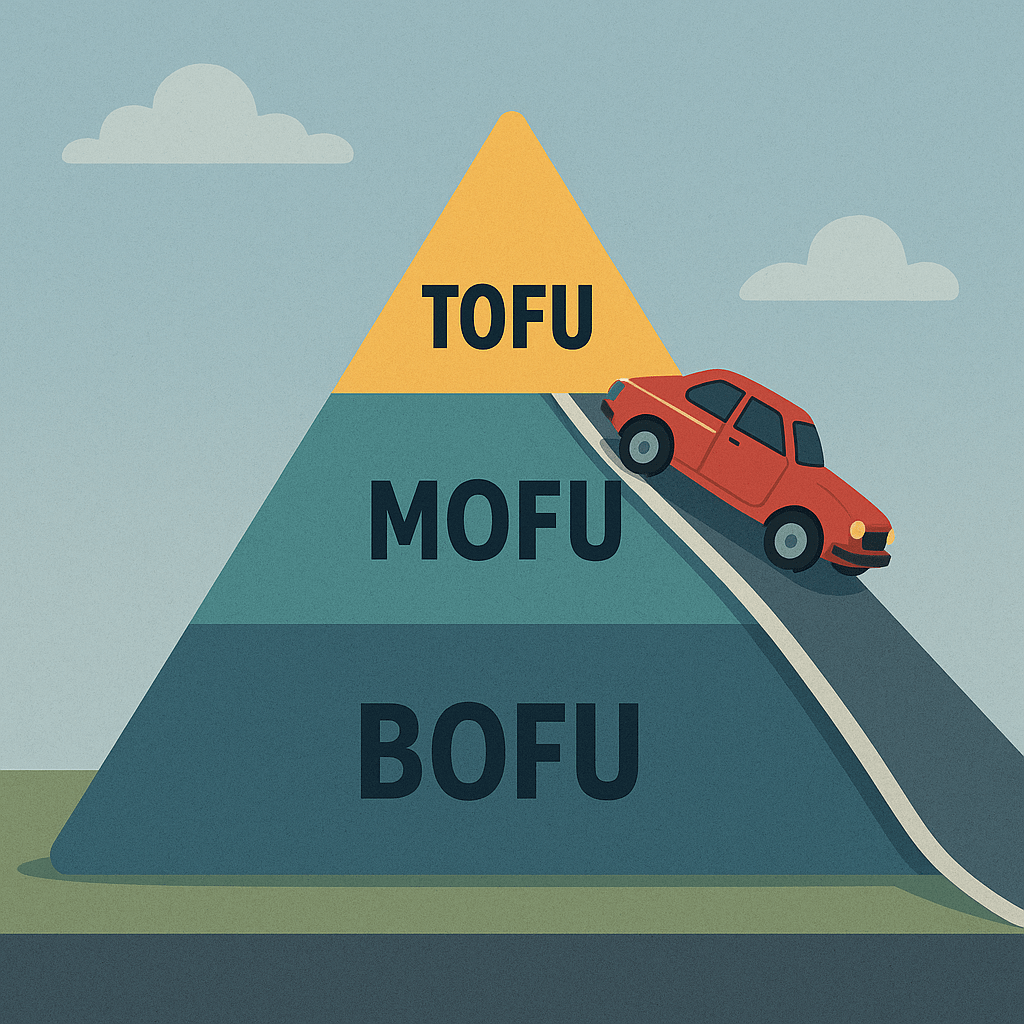
If your blog is stuffed with TOFU topics, you’re basically running a very successful educational charity. You’re getting lots of readers, but not many leads.
Here’s the thing: TOFU content attracts people who are only problem-aware. They are experiencing a symptom, a frustration, a challenge, or a roadblock. Something isn’t optimal, but they don’t always know what solutions exist; they may not even know that your product or category exists. In short, they’re just nowhere near ready to buy.
Take an HR tech vendor selling an employee recognition platform. Your TOFU topics probably look like:
- “How to improve employee morale.”
- “Signs of low employee engagement.”
- “What causes low employee engagement?”
Writing about these topics is a good start. You’re trying to capture the attention of people who are experiencing the problem your solution solves. They’re feeling the pain, but they’re definitely not thinking, “Ah, yes, time to evaluate recognition software.” They don’t even necessarily know that category of product exists.
So if your blogging stops at the TOFU level, you’re just collecting an “audience” of one-time visitors who will nod, and then happily disappear back into Google.
Practical exercise: Run a mini audit to determine the proportion of TOFU/MOFU/BOFU content in your blog. Changes are, you will find a disproportionately high number of TOFU articles.
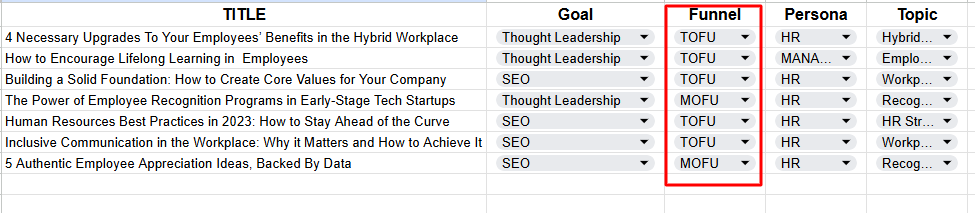
This is why MOFU content also matters. MOFU is where the buyer psychologically shifts from “I have this problem,” to “I know how I want to fix it.” They’re becoming solution-aware, which means they’re ready to dive deeper into solutions.
Using the same HR tech example, MOFU topics look more like:
- “How to build a recognition program.”
- “Best employee recognition platforms”
- “peer-to-peer recognition tools”
Now we’re talking. These pieces point directly to the category you sell in. They tee you up to mention your product without it feeling unnatural. And most importantly, it allows you to position yourself as a trusted authority in solving this particular problem.
Not Considering Search Intent
When choosing keywords, many people have traffic goggles on. In other words, they are seduced by those enticing traffic numbers and end up selecting keywords based solely on search volume.
While this approach may increase visits, it often results in a large volume of unqualified traffic—people with no real intention of evaluating or purchasing your company’s solution.
A more effective approach is to be systematic and use multiple criteria to decide which keywords to target, with search intent being one of the most important.

Search intent is commonly categorized into four buckets:
- Informational (learning)
- Navigational (finding a specific site/place)
- Commercial (comparing options)
- Transactional (ready to buy/act)
A strong blog strategy should still include informational content, mainly because it helps build domain authority and sends positive signals to Google. The key is balance. Alongside TOFU topics, you also want keywords with commercial and transactional intent. Meaning queries that come from people who are aware of their problem and are beginning to evaluate solutions.
When you align your keyword choices with both intent and ICP readiness, your traffic becomes far more meaningful. You’re not just attracting readers; you’re attracting potential customers.

Not Considering Who You’re Targeting
In B2B, there are often many people involved in the buying process, so you’re speaking to a mix of roles.
For example:
- Managers
- Directors
- Execs
Each of these people has different responsibilities, authority levels, and buying power. When you select topics or keywords, you should always ask yourself, “Is a decision maker likely to be searching for this?”
Using the HR tech example, imagine you sell employee recognition software. Topics like:
- “How to motivate employees.”
- “How to make your team feel appreciated.”
- “Low-cost ways to improve morale”
These are all useful, well-intentioned articles. They address topics and challenges in your industry. However, the people searching for those topics are typically middle managers or team leads; they aren’t the audience that can move a buying process forward.
Don’t just think about the topics, or even the topics with the highest search volume. Think about who exactly is searching for those key terms.
Because your actual ICP is probably searching for a very different type of thing. Their queries look more like:
- “Employee recognition software comparison”
- “How to scale a recognition program.”
- “Recognition platforms for distributed teams”
These topics reflect higher-level organizational concerns and align with someone actively evaluating solutions and with budget authority. Being intentional about who you target ensures your content doesn’t just attract readers, it draws readers who can become customers.
Weak or Misaligned CTAs
Even when the content itself is strong, many blogs still struggle to convert because their calls to action don’t align with where readers are in their buying journey. A CTA works only when it reflects what the reader is ready for.
A common example is placing a “Book a demo” button at the end of a very early-stage, educational article. Someone who has just arrived to learn what employee engagement even means is not ready to commit to a product conversation. The intent doesn’t match the ask.
A more structured approach helps ensure the CTA aligns naturally with the reader’s mindset. A simple way to think about it:
- TOFU → Soft CTA: Newsletter signup, templates, checklists, or light educational resources. The goal is to nurture, not sell.
- MOFU → Medium CTA: Case studies, comparison guides, playbooks, or webinars. These resonate with readers who are exploring solutions and evaluating approaches.
- BOFU → Hard CTA: Demo requests, free trials, pricing pages, or product tours. These make sense only when the reader is already problem-aware and solution-aware.
It’s also helpful to place CTAs in multiple locations. Mid-article CTAs can be kept subtle and contextual, and often perform better than those placed solely at the bottom. Product-led examples sprinkled naturally throughout the content (e.g., by referencing how your tool solves the issue being discussed) can guide the reader to the next step without feeling promotional.
The goal is to create a natural progression: wherever a reader enters, they should have a clear, appropriate path forward that matches their level of readiness.
The Quality Problem
Sometimes the issue isn’t your keyword strategy or your ICP targeting. Sometimes the content simply isn’t strong enough to build trust. If your content doesn’t convey depth, originality, or real expertise, readers won’t feel confident taking the next step.
You might look at your rankings and think, “But my articles are performing well on Google. Doesn’t that mean they’re high quality?”
Not necessarily. Google is full of articles that rank well but are deeply hollow in terms of value and originality. Search performance doesn’t always reflect usefulness or insight; in many cases, it simply reflects how well you followed SEO best practices.
I’ve written before about what makes content genuinely valuable, and strong content consistently embodies five characteristics: it is specific, relatable, helpful, credible, and human.
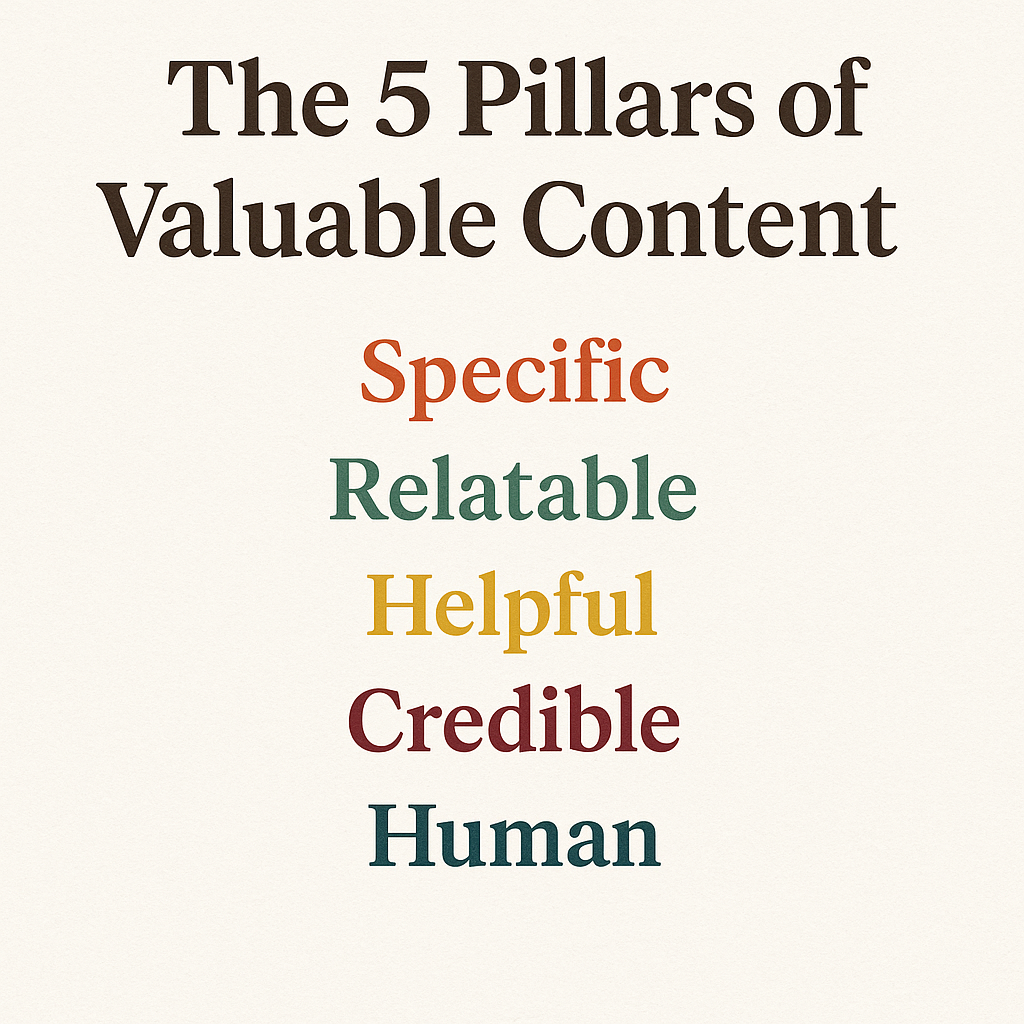
When even one of these elements is missing, the piece risks feeling generic. To avoid this, it’s helpful to do a self-check.
- Are you offering practical, detailed advice that speaks directly to your ICP’s real challenges? Or are you offering the same high-level guidance they could find on any blog?
- Are you supporting your points with examples, visuals, or data? Or relying on stock photos and long paragraphs of text?
- Are you backing up your content with credible sources, such as the voices of SMEs (subject matter experts), research, data, etc.?
High-quality content doesn’t skim the surface. It goes deeper. It demonstrates that you understand the nuances of your audience’s problem and know how to solve it. That level of depth is what compels a casual visitor to take action.
Don’t Forget: It’s a Long Game
It’s completely understandable to feel discouraged when you’re putting real effort into your blog and still not seeing leads come through. Slow results can feel like a sign that something is wrong. But in most cases, they’re simply a reflection of how content marketing works. It’s a long game.
Even if you did everything in this article correctly, content marketing remains a long-term strategy. These improvements will help attract a warmer, more qualified audience, but most readers still won’t be ready to buy the moment they land on your blog. Sorry.
The real purpose of content marketing is to nurture your audience through a connected ecosystem—your blog, social channels, newsletters, and product pages all reinforcing each other. It’s a system that rewards consistency, patience, and depth. When your customer is ready to evaluate solutions, your company is already top of mind.
Ultimately, traffic without an immediate pipeline isn’t a failure; it’s the starting point. Keep showing up with thoughtful, high-quality content, and the compounding effect will come, slowly at first, then all at once.
 Content Marketing For Small Businesses
Leave a comment