
If you’ve been in B2B marketing long enough, you probably remember the old days: publish a blog, share it once, and wait for traffic to roll in. It was the golden age of “ultimate guides” and “10 ways to…” posts. Simpler times.
But what worked in the Buzzfeed era of 2015 doesn’t work now. Today’s audience scrolls, skims, and skips. They can smell generic content faster than a cookie pop-up. Even when using traditional search engines, nearly 60% of all Google searches end without a single click.
The internet changed faster than most marketers did. Suddenly, writing “10 Ways to Improve Your Team’s Productivity” didn’t make you look helpful; it made you sound like a torpid corporate copycat.
The problem is that most B2B companies have never updated their strategies. They’re still playing by rules written in 2015 and wondering why their content isn’t performing as expected.
This isn’t about abandoning the fundamentals; it’s about evolving them. The new rules of B2B content marketing aren’t about algorithms or hacks. They’re about focus, conviction, and writing like someone’s actually going to read it.

From Blog Posts to Content Ecosystems
- Old Way: Your content starts and ends with your blog post.
- New Way: Your blog is the starting point, not the finish line.
For years, the blog post was the centerpiece of B2B content marketing. Then came the hot takes: “Blogging is dead!” (It’s not. Calm down.) In my opinion, the blog post isn’t dead; it’s just evolved.
You see, attention spans have shrunk, and the way people want to consume information has changed dramatically. Between social media feeds and short-form formats like vertical videos and carousels, audiences don’t necessarily want to learn by slogging through a 2,000-word post.
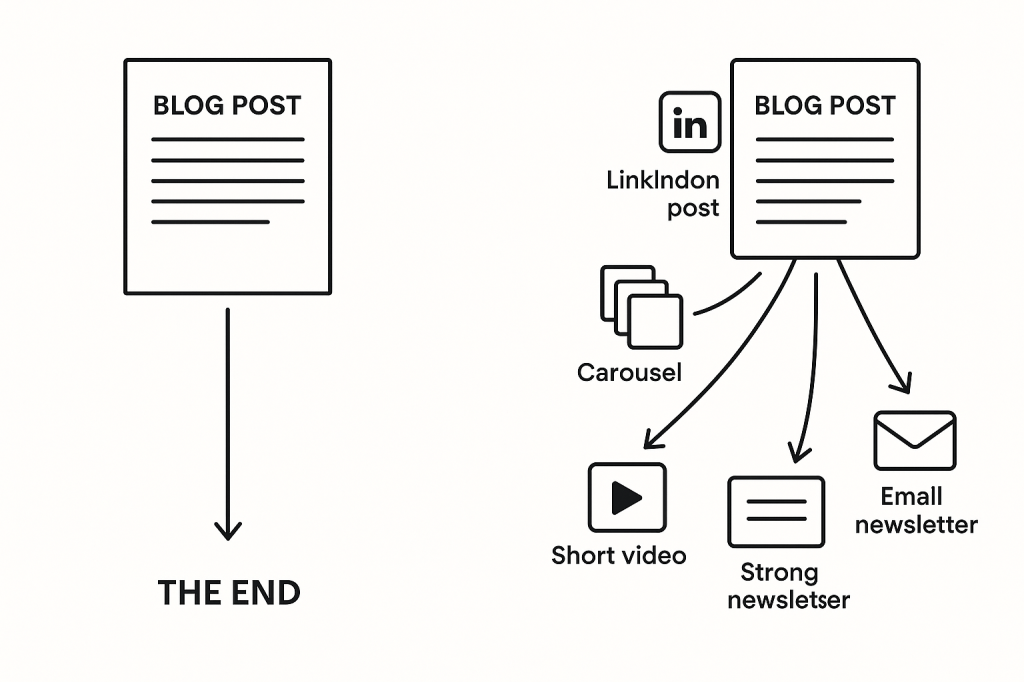
Today, the blog is still your hero, but it’s a central node, not a final destination. It’s your content nucleus: the piece you break down, remix, and redistribute into new formats.
- Old content workflow: write → publish → share once → move on.
- New workflow: write → atomize → redistribute → remix.
With the advent of AI tools, it has become much easier to transform a single blog into multiple assets, such as LinkedIn posts, carousels, short videos, email newsletters, and quote graphics. In essence, your blog becomes your content nucleus, feeding multiple touchpoints across your funnel.
From Chasing Volume to Chasing Expertise
- Old Way: You write to rank.
- New Way: You write to position yourself as an expert.
SEO used to drive everything. Keywords = king.
If your content ended up ranking for those keywords, you could bask in the glow of sweet, sweet traffic. Ranking for high-volume keywords can bring more eyes to your site. Ultimately, those are just vanity metrics. In other words, traffic doesn’t guarantee leads, and it’s a far cry from actual paying customers.
The bigger issue? Building your content strategy around keyword volume leads to a disjointed blog. You end up covering whatever the search data says people want, which means your content sprawls across a dozen unrelated topics. The result: a blog that’s wide but shallow — and therefore, not particularly authoritative on anything.
Building your content strategy around keyword volume leads to a disjointed blog.
Positioning yourself as an expert flips that order. First, decide what you want to be known for. Then, do your keyword research within that space. Focus your content around a few core themes so that, over time, you build depth, not just breadth.
The best content starts where SEO data stops—in Reddit threads, Slack communities, customer calls, and all the messy corners where real problems get discussed. That’s where you find potent insights no keyword tool will ever offer you.
Example:
Instead of writing a generic post like “10 Ways to Improve Employee Productivity,” take a more authoritative angle.
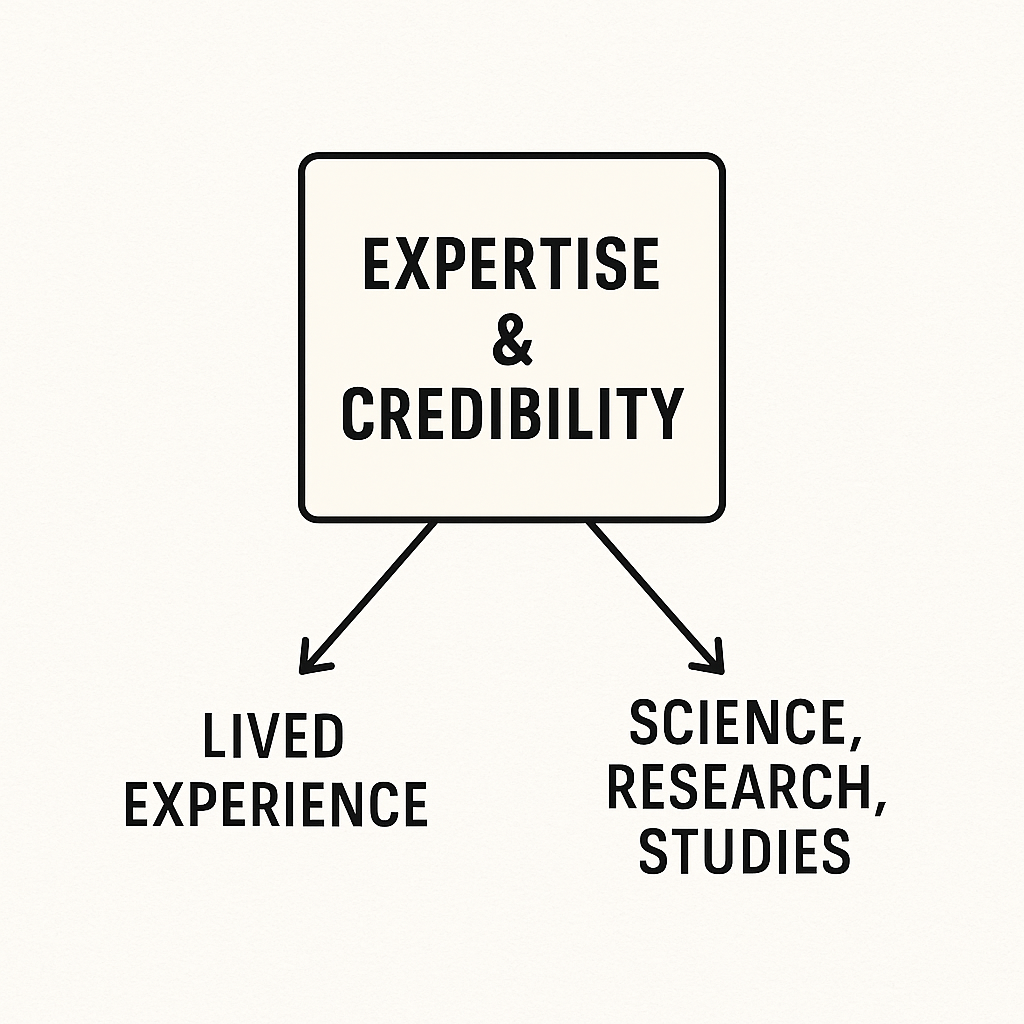
- You could write from lived experience—“What Happened When We Tried to Improve Productivity by Cutting All Internal Meetings in Half.”
- Or you could write from evidence and research—“What the Latest Psychological Studies Reveal About Employee Productivity (and Why We’ve Been Measuring It Wrong).”
See the difference? One tells a story. The other teaches something grounded in research and science. Both positions you as an expert.
Start pulling in the voices that actually matter, like your subject-matter experts, your customers, and even your own lived experiences. Chances are, people inside your own company have already faced (and solved) the very challenges you’re writing about.
Talk to them. Yes, it takes more time than cranking out a generic listicle, but that time is well spent. It makes your content richer, more valuable, and far more likely to make an impact. That’s how you turn your content from generic advice into genuine authority.
From Broad Audiences to Specific Profiles
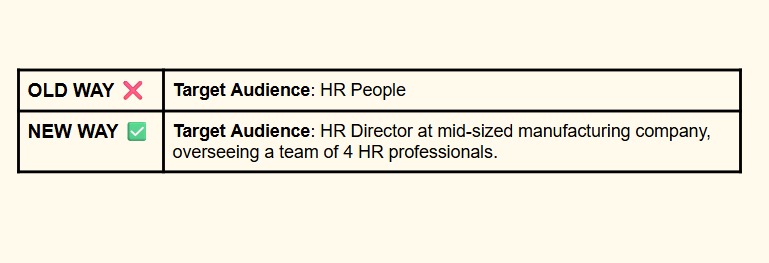
- Old Way: You write for “HR professionals.”
- New Way: You write for HR Directors at a specific company type.
Generic audiences produce generic content. There’s a big difference between a 25-year-old HR generalist at a startup and a 50-year-old HRBP at a multinational. Their challenges, language, and incentives differ wildly. When you lump them together, your content loses credibility.
On the other hand, the narrower your audience, the sharper your message.
You can define your audience across a few key dimensions:
- Organizational level: generalist, manager, director, VP
- Primary function: employee relations, recruiting, payroll, comp & benefits
- Company size or maturity: startup, mid-sized, enterprise
Even if you never spell these traits out in your content—you’re not literally saying, “Hey, HR Director Dina at a mid-sized manufacturing company,” knowing who you’re writing for quietly shapes how you write. You show, not tell.
And that’s not just a marketing trick, it’s the foundation of good storytelling. Great creative writers don’t tell you a character is nervous; they describe how their hands are trembling uncontrollably. The same principle applies to B2B content. When you demonstrate that you understand your audience through tone, examples, and context, you don’t have to announce it; they just feel it.
From Corporate to Human
- Old Way: The business is the de facto expert
- New Way: People are the experts
There was a time in B2B content marketing where companies were the self-appointed “voices of authority.” The company itself was an all-knowing oracle that could write authoritatively on any subject and sign its blog posts as “The Team at ZoomTree.”
Cue the era of the independent creator. Naturally, this changed what audiences value. People no longer turn to faceless corporations for answers; they turn to individuals with credibility, personality, and a pulse. People trust people, not logos.
For B2B brands, that means rethinking the messenger. The most trusted voices aren’t “The Team at ZoomTree.” They’re your actual engineers, your founders, your customers; it’s the people who actually do the work.
The company’s role now isn’t to speak on behalf of experts, but to amplify them.
Examples:
- Instead of a company blog post titled “The Impact of AI in HR,” you have your CTO post, “What building AI Tools for HR Taught me About Human Bias.”
Instead of marketers ghostwriting sterile blogs, have them help internal experts shape their raw thoughts into authentic stories. Today, credibility doesn’t come from being overly sterile and corporate; it comes from being genuine and human.
From Neutral Information to Strong POV
- Old Way: Stay neutral. Be educational. Avoid opinions.
- New Way: Have a point of view. Build a narrative. Lead with conviction.
There was a time in B2B history when the goal of content was to inform. Write something informative, target a high-volume keyword, and boom, you’re doing “content marketing.”
As a result, the corporate blog became a patchwork of SEO topics—a disconnected library with no unified message, no personality, and no reason to care.
This type of neutral content no longer cuts through the noise. The new era of content demands a strong editorial point; this consists of a unified narrative anchored in core beliefs, recurring themes, and consistent stances.
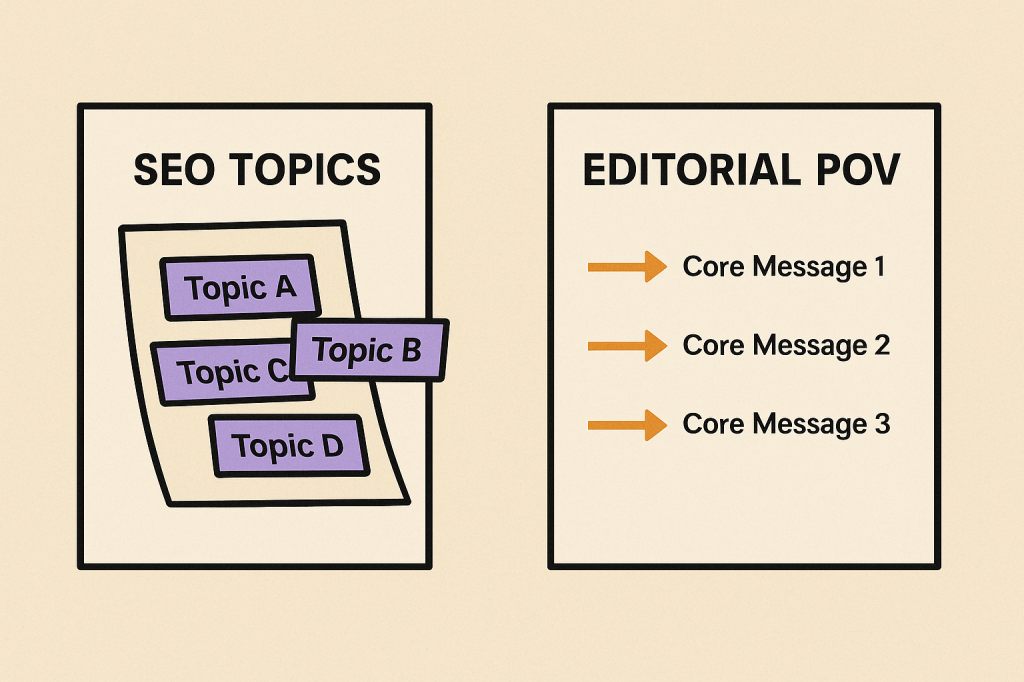
For example, if you’re an HR tech company focused on employee recognition, your core messages might be:
- Culture isn’t built by policies; it’s built in small, everyday moments.
- Employee recognition isn’t fluff; it’s a business-critical system.
- If you can’t measure it, you can’t improve it, and culture is no exception.
- Traditional recognition is broken, and it’s HR’s fault for turning it into a quarterly campaign.
In short, every blog, social post, and campaign should echo these core beliefs when appropriate. You’re not just sharing information; you’re shaping opinion, context, and direction.
Strong content positioning and POVs create brand memory. People start associating your name with a worldview, not just a topic bucket like “employee recognition” or “leadership best practices.” When your content aligns around a few bold ideas, it stops being random; it becomes a body of thought.

Struggling With Your B2B Content Strategy?
I help small B2B teams turn content into a focused, strategic asset.
Closing the Time Capsule
Don’t burn the old rulebook; just seal it in a time capsule, right next to the other relics of 2015: BuzzFeed quizzes, skinny jeans, and that primitive cartoon lightbulb infographic.
What once made brands look credible now just makes them look generic and bland. You can’t keyword-optimize your way into trust or publish your way into authority anymore.
Today’s audiences don’t want more surface-level information; they want a strong and nuanced POV. They’re drawn to brands that think deeply, take a stance, and sound unmistakably human. The future of content is about building a body of thought.
This new era belongs to those who sound less like a marketing department and more like they’re genuinely trying to help; they amplify the voices of real experts, not hide behind them.
 Content Marketing For Small Businesses
Leave a comment