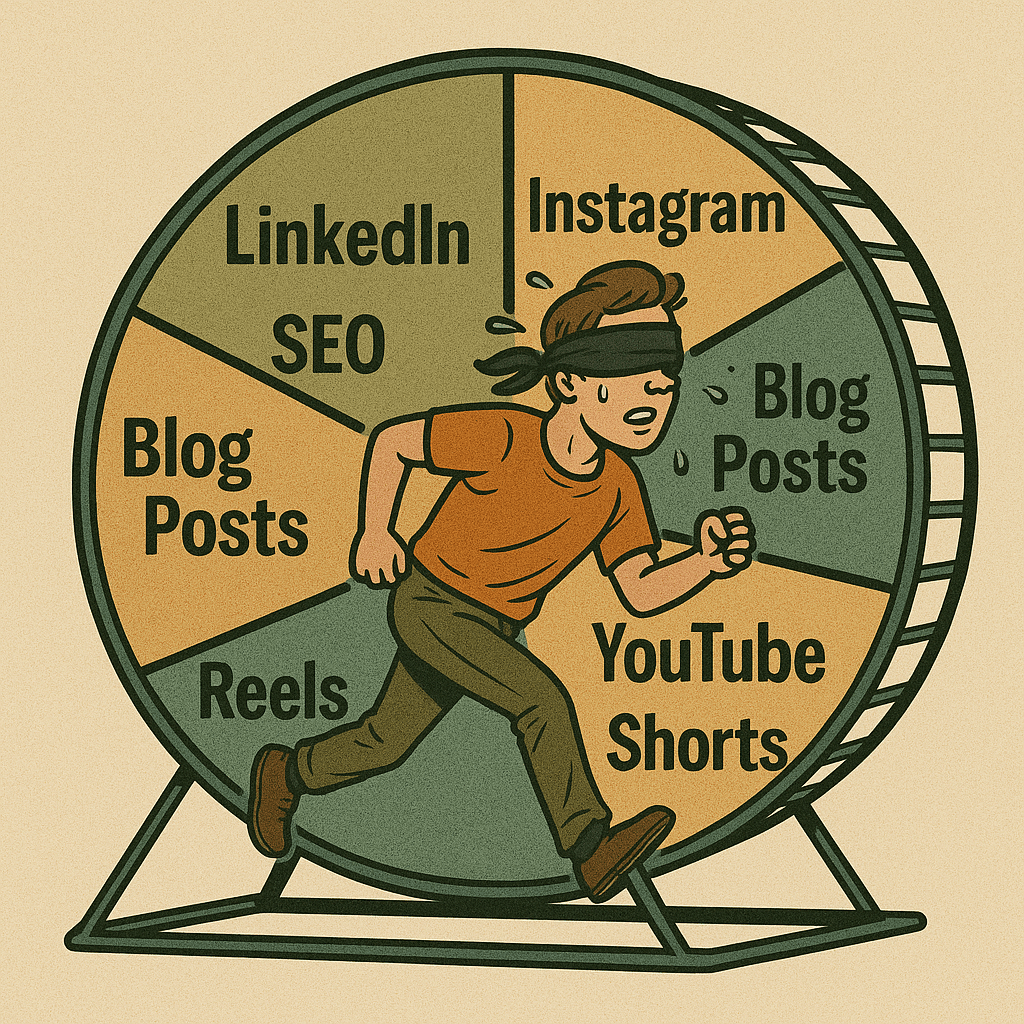
Most companies think they have a content strategy, but what they actually have is a publishing schedule.
I’m guilty of this myself. Early in my career, I worked with early-stage startups, where “strategy” meant publishing content on topics and formats that seemed popular and relevant, and doing more of what seemed to work.
In hindsight, this wasn’t a terrible approach. You have to start somewhere, right? And we did end up getting some great results for the stuff that did work. But, looking back, it’s clear there was a lot of lost time and resources on things that didn’t really pay off. In short, there was a lot of aimless publishing.
Signs of a weak content strategy
Without a strategy, long-term, your content team ends up running in circles: pumping out posts, chasing keywords, and reacting to trends.
It is usually easy to tell when a company lacks a strong content strategy:
- You read their content and find yourself wondering, “Who exactly is this talking to?” The language is too broad and generic; it feels like it can be written for anyone.
- They’re producing “safe” copycat content. They lean towards top-of-funnel, educational pieces, such as “What is X?” that look like what everyone else is writing. If they write a thought leadership piece, they’re never leading the conversation; they’re just echoing it.
- Nothing builds on anything. Every post starts from scratch instead of reinforcing and repeating a clear message or point of view.
- There are inconsistencies everywhere in the quality of the writing, tone, formatting, style, and the topics chosen.
If your business is just starting out, it’s normal to feel a bit lost, to not have a super well-defined strategy. Your “strategy” might just be let’s start a blog about X topics, and that’s it. Sometimes you just need to start publishing, that’s OK.
But over time, “just publishing” won’t cut it, especially in this competitive landscape.
A solid content strategy will set your business apart in the noisy sphere of internet content. In other words, it’s not just about creating one-off pieces that end up gathering cobwebs in the content graveyard, but treating content as an extension of your brand, values, and what your company stands for.

A lot of advice about content strategy from supposed marketing “gurus” is very theoretical and filled with flowery marketing jargon. But creating a content strategy is a lot more concrete and practical than that.
When developing a content strategy, I typically include the following five core pillars that make up the crux of the plan. Let’s dive into each one a little bit deeper.
1. Content Analysis and/or Audit
If your business is just starting out, you obviously won’t be able to analyze the performance of your content, because you don’t have any.
In this case, I would recommend a high-level competitor audit to understand what your competitors are producing in terms of content and the quality bar you are benchmarking against.
You essentially want to try to reverse-engineer their content strategy. Look at what types of content are they publishing, how often, what channels, what formats, etc? This will serve to establish a benchmark for your own publishing in terms of quality and quantity. This will also help inform your content positioning for later stages of strategy development.
On the other hand, if you have legacy content or a library of older content, I recommend examining your highest-performing content in terms of page views or visits, as well as your lowest-performing content. Then try to decipher some patterns to understand what types of content and formats consistently perform higher and why.
2. Content Marketing Personas
I often read B2B blog posts where it’s painfully clear the writer has no idea who they’re talking to. “HR people,” or “developers.” That’s way too vague.
Writing for an HR director with budget authority is very different from writing for a junior HR generalist doing preliminary research. When content speaks to everyone, it fails to connect with anyone.
You don’t need a 20-page persona document. You just need clarity about who you’re trying to reach, what they care about, and what their biggest problems are. You need to learn to speak their language, use their jargon, and their industry acronyms. In my experience, the moment content teams start writing with a specific reader in mind, performance and engagement improve dramatically.
We won’t dive too deeply into the subject of how to develop content marketing personas; I will save that for another post. But I wanted to mention it, as it’s a critical foundational piece that will inform the rest of your content strategy.
3. Core Message & Positioning
There was a time when it was acceptable to simply produce top-of-funnel content, such as “What is X,” and consider it a success. As I wrote in my recent article, weak position is the enemy of good B2B content marketing; now we need to think a little more strategically to stay competitive.
A great place to start is with an audit of your competitive landscape. Pick 2-3 of your top competitors and ask yourself some of these questions.
- What are the topics they are writing about?
- What content mediums are they using (video, blogs, etc)
- What is their voice and tone?
- What content format are they using? (i.e list articles, case studies, etc)
I made a simple illustration that helps you plot competitors on an axis between human ↔ corporate and entertaining ↔ educational. Once you map that out, you can decide where your company’s content should land.
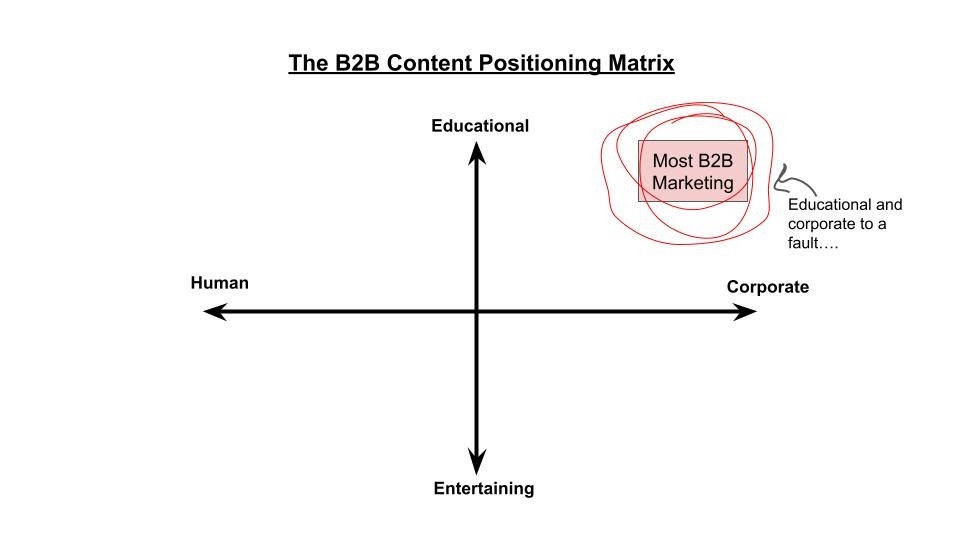
Not everything has to fit neatly into a box; for example, some content will naturally be more educational by virtue of its topic or format. That’s OK. The goal isn’t rigidity; it’s consistency. Your tone and feel should align with your broader marketing so your content feels cohesive across the board.
Core messaging
Think of your core message as the belief or value your business stands for. This belief should be woven into everything you publish, no matter the medium.
For example, my own core belief as a content marketer—the thread that runs through all my work—is that differentiation is critical to content marketing success in 2025. Playing it safe and pumping out generic content is the fastest way to blend into the noise of the internet.
Now, don’t overthink it. If your business is still early-stage, you don’t need to have this perfectly defined. Your core message will grow and change as you publish, get feedback, and learn what resonates. In my experience, the clarity often comes with time, especially once you’ve been in the trenches creating content, talking to experts, and seeing what actually works.
4. Distribution
Content distribution is often an afterthought, but it should be one of the first high-level decisions you make when developing your content strategy.
Content distribution simply refers to the channels by which we will distribute your content and ideas.
- Social media (i.e. Linkedin, TikTok, Instagram, YouTube, etc.)
- Google Search (SEO)
- Content platforms (i.e. Medium, Substack)
- Podcast
- Newsletter
Ideally, you don’t want to go too hard too soon. You also want to select channels where you know your target audience is active.
If you’re just starting out, it can be tempting to just tackle all these channels at once to maximize your visibility. In my experience, this always backfires, especially if you don’t have the manpower to sustain it. Pick 1-2 core channels, establish a steady content operation, and work your way up from there.
5. Business Goals
Here’s what a day in content marketing can look like:
Slack pings from a Customer Success Manager: “Hey, we need a quick article explaining this feature, our customers are confused.” A sales rep chimes in: “Can you update the comparison sheet? I need it for a hot lead.” Meanwhile, your publishing calendar is packed with deadlines for blogs and social posts.
Every team wants something different: awareness, sales enablement, or customer education. The content team sits at the center of it all. Without a defined strategy, your energy gets pulled in ten directions, and time and energy ends up getting wasted on things that aren’t a real priority to the business.
This is where you want to keep that classic marketing funnel in mind: TOFU, MOFU, BOFU.

I mostly worked in the startup environment, where companies were building their content libraries from scratch. In this context, it didn’t make sense to prioritize customer enablement or even sales enablement—we had no customers! And leads were few and far between.
In this case, we typically prioritized TOFU content to try to increase our brand visibility and attract potential buyers. Some of these potential buyers may not even know that the category or solution even exists. But, as the business grows, leads flow into the pipeline, and customers get onboarded, the content output will become a little more diversified.
Ultimately, with a strong content strategy, you want your content portfolio to be composed of a nice balance of all three: TOFU, MOFU, BOFU.
Keeping your strategy tied to execution
You created a beautiful content strategy, maybe you even did a presentation on it, but it sits in your Google Drive just gathering dust now. To be clear, you should always document your content strategy. I typically do one big yearly one and a mini refresh every quarter.
But the point I want to drive home is that your content strategy is not a document. These ideas and goals should be tied to every initiative you take in content.
Concretely speaking, every piece of content had the strategic direction outlined at the top:
- Who is this being written for (persona)
- What point are they in the buying process – tofu, mofu, bofu (business goal)
- What brought them here, and how should they walk away feeling (positioning and core message)
When those factors are well thought out and articulated, your content goes from being generic and scattered to highly targeted and purposeful.
Building a Well-Oiled Machine
It’s critical to remember that content is a long game. You won’t see overnight wins here.
It can take time to find your voice, build momentum, and deeply understand your audience’s needs. The unfortunate truth is, most small businesses have tons of competing priorities and lose momentum before that sweet compound interest kicks in.
But if you continue to fine-tune your strategy and keep up the momentum, you will build a well-oiled content machine that drives awareness to your business while you sleep.
In other words, a strong content strategy gives your efforts longevity. It turns what could’ve been a random collection of blog or social media posts into a flywheel that keeps working long after the publish date. It’s about publishing with more intention, precision, and purpose. Over time, that’s what turns your content into a real competitive advantage.
 Content Marketing For Small Businesses
Leave a comment